
From Desert Dhablas to Modern Runways: The Evolution of the Kachchh Shawl
The Genesis: The Dhabla (Kachchh Shawl) as a Desert Survival Tool
The journey of the Kachchh shawl began not as a luxury garment, but as a rugged necessity for survival in the arid salt marshes of Gujarat. For over 600 years, the Vankar (weaver) community has crafted the dhabla—a heavy, coarse woollen blanket designed to withstand the extreme climate of the Safed Rann.

In its most traditional form, the dhabla served as a multi-purpose tool for the Rabari pastoralists. Its weave was so dense and tight that it functioned as a "protective raincoat," capable of repelling water during the monsoons. At night, it transformed into a wind-cheater and quilt to ward off the desert chill. Because early looms were narrow, a dhabla was typically woven in two separate lengths, which were then meticulously joined at the center using a decorative "fish stitch" known as "machi-kandha" "khelavni".
Traditional Role | Functional Utility | Material Context |
Raincoat | Tight weave prevents water penetration. | Hand-spun local sheep wool. |
Quilt/Bedding | Heavy two-ply yarn for thermal insulation. | Desi/Patanwadi sheep wool. |
Cultural ID | Motifs denoted community status and belonging. | Natural dyes: Indigo, Madder, Lac. |
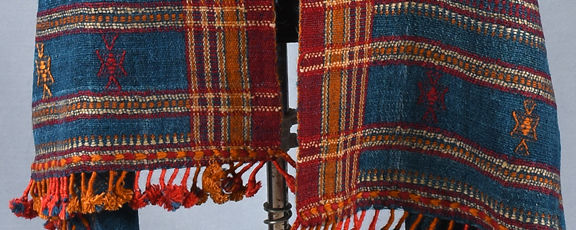
The Vankar-Rabari Symbiosis: A Circular Heritage Kachchh Shawl
The evolution of the shawl is inseparable from the unique barter system that defined the Kutch region for centuries. This was a tripartite ecosystem involving the Rabari herders, the Vankar weavers, and the Rabari women dyers.
The Rabaris provided the raw materials—fleece from their indigenous desi sheep and goats. The Vankars then processed this wool through rigorous cleaning and hand-carding before spinning it on the traditional charkha. In exchange for their weaving skills, the Vankars received milk, grain, and animal products from the pastoralists. This closed-loop economy ensured that the craft remained resilient against external market forces for generations.
Technical Mastery: The "Extra-Weft" Sorcery
The hallmark of the Kachchh shawl—and its later evolution, the Bhujodi saree—is the extra-weft technique. Unlike printed fabrics, these textiles "sculpt" patterns into the fabric during the weaving process.
Using a horizontal pit loom, the weaver manually lifts specific warp threads with their fingers—without the aid of a Dobby or Jacquard mechanism—to insert supplementary weft threads. This labour-intensive process, which can take up to 10 days to set up a single loom, creates three-dimensional geometric motifs that are often perfectly mirrored on both sides of the cloth.

The Architecture of the Pit Loom
The pit loom itself is a marvel of desert-adapted engineering. It is partially set into a 2-foot-deep pit, allowing the weaver to sit at floor level and use their body weight to operate the treadles (foot pedals). This configuration reduces back strain during 10-hour weaving sessions.
Component | Function |
Thambla | The large wooden frame fixed into the ground. |
Pankha | The beater that secures the weft into place. |
Athh Tako | A technique using four pedals to create complex textures. |
Tor | The beam where finished fabric is wound. |
A Lexicon of the White Rann: Symbolic Motifs
The motifs woven into a Kachchh shawl constitute a "tribal lexicon," preserving stories of survival and reverence for nature. Most are geometric, as the linear nature of the loom makes curvilinear shapes difficult to produce.
Chaumukh: A four-sided motif representing cosmic unity and the Mandala.
Satkhani: A seven-step pattern symbolizing the layers of the universe or a righteous life.
Hathiya: Stylized elephants signifying royalty and wisdom, often found in bridal dowries.
Wankia: Zig-zag lines inspired by the footprints of an animal herd or a winding river.
Chomak: A scorpion pattern woven into borders as a talisman to ward off evil.

The Modern Pivot: From Utility to Global Fashion
The 1960s marked a turning point for Kutch weaving. As mill-made cloth began to dominate the local market, the weavers of Bhujodi faced a crisis. In response, they formed the Bhujodi Weavers Co-operative to target urban and international markets.
This era saw the traditional dhabla evolve into the contemporary Bhujodi Saree. Artisans widened their looms and experimented with finer thread counts—moving from 24 threads per square inch to as many as 70. While wool remained the winter standard, the introduction of Kala Cotton—an indigenous, organic, and rain-fed variety—made the textiles accessible for summer wear.
Today, the Bhujodi weave is celebrated on international runways. Master artisans like Vankar mix heritage motifs with modern trends, such as deep indigo dyes and Tussar silk blends, creating "wearable history" for a global audience.
Sustainability and Protection: The GI Tag
In 2012, the Kachchh shawl was granted a Geographical Indication (GI) tag. This legal Armor ensures that only authorized artisans in Kutch, using traditional methods, can market their work under the Kachchh name.

This status is vital for economic preservation, protecting over 1,200 weavers from cheap power-loom imitations. It also highlights the craft's sustainable roots; between the use of carbon-neutral Kala cotton and natural dyes like pomegranate and indigo, the Bhujodi weave stands as a beacon of eco-conscious slow fashion.
Conclusion: The Rhythmic Beat of the Loom
From the rugged blankets of nomadic herders to the luminous sarees found in high-end boutiques, the Kachchh shawl remains a testament to the resilience of the Vankar community. By preserving the slow, rhythmic beat of the pit loom, these artisans ensure that the history of the desert is not just remembered, but worn. Supporting authentic Bhujodi weaving through platforms like craftcentres.com contributes to the survival of a heritage that is as enduring as the Rann itself.


Comments